
I've previously reviewed and enjoyed a couple of books that Mattia Zamboni has been involved with, notably Amazing Vehicles and its sequel More Amazing Vehicles both of which he co-wrote with Nathanael Kuipers. When publisher No Starch Press got in touch to let me know that Mattia had a new book on the way, therefore, I was keen to take a look....
Mattia, a LEGO-loving graphic designer from Switzerland, has collaborated with contributors from around the globe to produce Tiny LEGO Wonders, a book which celebrates microscale models. The book's release is well-timed, with microscale seemingly firmly in fashion right now if the number of related magazine articles, books, official LEGO releases and MOCs is anything to go by. Each of the eleven contributors has submitted a number of microscale designs, making a total of forty designs in all which are showcased in the book.

The book is organised around ten themed chapters, each of which provides a suitable setting for a number of featured microscale builds. Each chapter kicks off with a two-page spread showing a brick-built microscale diorama, for example the scene above which illustrates the "Fire!" chapter, and the featured builds are suitably positioned within this diorama. These brick-built backdrops are generally superbly realised, and for me they're a real highlight of the book - a perfect reminder of the surprising level of detail that can be captured at this scale.

Each chapter showcases up to six themed microscale builds. First up we have "The Train Station" which includes three trains and a touring coach, followed by "The Airport", "Fire!" and so on. It's immediately evident that the featured builds, which include the Intercity Express above, are really quite impressive and of a consistently high quality. As you'll have noticed from the picture above, being showcased in the book doesn't just mean the inclusion of a couple of pretty photographs - each featured design is accompanied by an inventory of the elements needed to build it, and also a set of building instructions, thus allowing the reader to relatively easily reproduce the designs themselves.
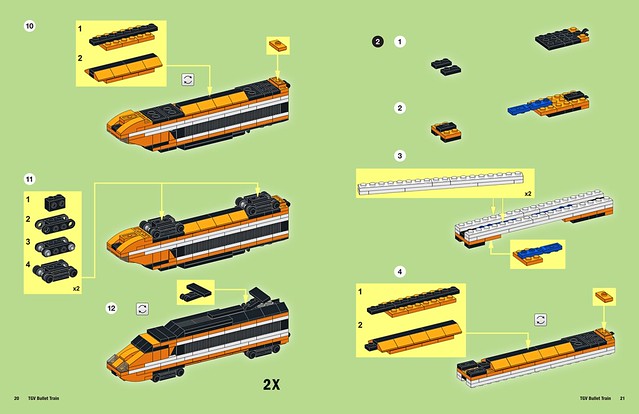
The TGV Bullet Train above, which many LEGO fans will immediately recognise as a microscale version of an official LEGO set - 10233 Horizon Express - is one of my favourite builds featured in the book, although it's only one of many genuinely eye-catching designs on offer including a superb bulk carrier, a collection of excellent Formula 1 cars, a cracking little F-15 Eagle, a space shuttle plus crawler transporter, and many more. While the majority of builds are representations of real vehicles, the book does eventually deviate into fantasy territory with a number of sc-fi military vehicles featured in the final chapter, "The Moon Army". Overall, there's a nice varied selection of vehicles included in the book, although it's a crying shame that the scope doesn't extend to other types of models as well, for instance buildings, or perhaps even some of the environmental features which appear in the superb brick-built dioramas.

Before you can build anything you'll obviously have to accumulate the necessary elements and that's when things become tricky. Mattia's previous books featured designs which could all be built in their entirety using the elements contained in just one inexpensive Creator set, which I thought was an absolutely genius idea. In contrast, however, the elements needed to construct the 40 microscale builds in this book, or even just a couple of them, aren't to my knowledge readily available in a single set. Furthermore, my impression is that for many of the builds, some of the constituent elements probably aren't the kind that you're likely to have lying around in any quantity either, necessitating a visit to the likes of Bricklink. For the average AFOL that's probably not going to be a big deal, but for the more casual LEGO fan, sourcing the parts needed to build even the simplest of the models as designed could potentially be quite a challenge.
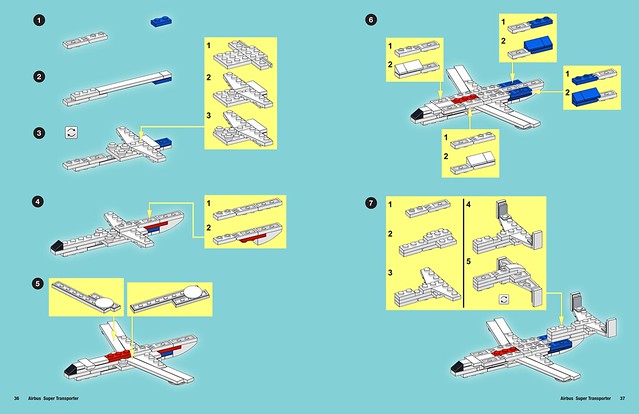
Looking beyond the actual content for a moment, I'm pleased to report that the book's presentation is up to the usual high standards that we've come to expect from No Starch Press. It sports a hard cover, and the quality of printing, photography and digital renders is excellent throughout the book's 200 pages. While I'm yet to attempt any of the builds myself, the instructions look to be clear and fairly easy to follow; although they lack the part callouts that LEGO routinely includes in building instructions these days, the builds are small and simple enough that this shouldn't be a problem for most builders.

In summary, Tiny LEGO Wonders is a beautifully presented book which is a pleasure to browse. It contains 40 microscale vehicle designs of consistently high quality, and the accompanying parts inventories and building instructions mean that readers can in theory attempt the builds for themselves. Furthermore, the book includes a number of delicious microscale backdrops within which the featured models are displayed, and to be honest if these fail to inspire then perhaps microscale building just isn't for you. On the downside, in contrast to the author's previous books which showcased models which could be built with the elements contained in just one inexpensive set, elements needed to construct the featured microscale builds here aren't to my knowledge available in a single set and would therefore likely have to be sourced from the likes of Bricklink which might put off less experienced builders. Also, it's disappointing that only vehicle designs are included in the book; the dioramas provide a tantalising glimpse of the kind of impressive structures and scenery that can be built at this scale, and it would have been great if parts inventories and instructions for a few non-vehicle builds had been included as well. All things considered, however, it's easy to recommend Tiny LEGO Wonders, and I'm looking forward to attempting a few of the builds myself....

Tiny LEGO Wonders will be available from the end of this month. At the time of writing, Amazon's UK site is quoting an RRP of £13.50 for the book which to me seems pretty good value for a 200-page hardback, especially as Amazon are slightly discounting the book; please use the Gimme LEGO affiliate link here to purchase if you're thinking of buying from Amazon in the UK. Amazon are also selling the book at a discount in the U.S., and you can find the link here.
Many thanks to Siobhan at No Starch Press for sending me a copy of the book to review on Gimme LEGO.
Showing posts with label No Starch Press. Show all posts
Monday, 25 July 2016
Tuesday, 26 August 2014
An Art or a Science ?
The Art of LEGO Design by Jordan Schwartz is the latest in a procession of adult-oriented LEGO-related books from No Starch Press to drop through my letterbox. The timing was perfect - it arrived just as I was casting around for some suitable holiday reading - so I gratefully shoe-horned it into my already overstuffed suitcase and took it away with me. The book's a further illustration of the astonishing diversity of LEGO-related print offerings available at present; previous Gimme LEGO book reviews have included a Technic reference manual, a coffee table LEGO art book, a couple of books crammed full of instructions for MOCs of vehicles (here and here) and a Neo-Classic Space Bible. The Art of LEGO Design occupies yet another sub-genre, dealing as it does with a study of building techniques rather than just showing off a selection of finished creations.
According to the press release which accompanied my review copy of the book, author Jordan Schwartz became one of LEGO's youngest-ever designers when he landed an internship in Billund at the age of 18. While working for LEGO he was part of the Creator/Creator Expert team and worked on the likes of Set 10232 Palace Cinema. The Art of LEGO Design is his first book, aiming to provide practical guidance to LEGO builders, cast some light upon the thought processes underpinning the design choices of expert builders, and provide inspiration for those of us looking to build our own LEGO creations.
The book is a hefty, soft cover affair containing around 270 pages in total. The binding is nice and sturdy and the book feels well put together. The simple front cover features the image of a Nepali Tata Truck, a model which is featured in the book; similar to the cover of the recently-reviewed LEGO Space book from the same publisher, the image is glossy and therefore 'pops' against the matt background. The back cover (above) contains a succinct but representative summary of the book's aims and contents, plus a close-up of the author's model of Rob Serling from The Twilight Zone, so you know that he's got good taste in TV at least. After some introductory words we're into the first of thirteen chapters, each of which is split into a number of subsections. The ordering of the chapters seems a little random at times, for instance the chapter which focuses on the use of LEGO figures (minifigures, Fabuland, Belville, Technic and hybrids of these) in builds preceeds the chapter addressing fundamentals of brick, plate and slope geometry; that having been said, there's a comprehensive 3-page list of contents, and that together with the detailed 8-page index means it's easy to find what you're looking for.
So here's the thing: designing and building your own models from scratch is a very personal thing I reckon - while there may be certain common behaviours and approaches among builders, when it comes down to it we all do things our own way. Anybody approaching the book looking for a definitive guide to MOCing is therefore likely to be disappointed I think - there's no 'right' way to do it, and each builder eventually figures out a style and approach of their own. While reading the book I was struck by how differently Jordan Schwartz approaches the task compared with how I like to do things; I tend to design my MOCs using computer design tools like LDD and don't trouble myself with tape measures and sketch pads which the author deems "indispensable building tools". That being said, I did find it interesting to observe the design and building process through the eyes of another builder, particularly someone with such an impressive track record, not to mention a different building style to mine.
What struck me most when I initially dived into the book was the sheer variety of content; I guess some might perceive the choice of subjects covered as idiosyncratic or even incomplete, but in reality it's just a reflection of the author's own modus operandi and preferences and it once again highlights the subjective and individual nature of the design and building process. Having discussed "Inspiration and Preparation" in the first chapter, followed by the use of the various types of LEGO figures in chapter two and then basic brick, plate and slope geometry in chapter three, there's a lengthy section on planning, building and framing mosaics. This chapter features the first of a number of brief interludes where the author 'interviews' renowned builders who specialise in some of the techniques, styles and MOCs featured in that particular chapter. In this case there's a short Q & A with Katie Walker a.k.a. eilonwy77 on Flickr whose mosaics are I think among the best in the business. I like these digressions - they reinforce the point that there's no "right" way of doing things and provide insights into the way that a number of outstanding builders go about their business. After patterns the book moves on to textures, predominantly the use of fabric and rubber elements; while some of the techniques presented give rise to effects which perhaps don't look sufficiently 'LEGO' for my taste there's no doubting the fact that the techniques are ingenious and impressive. We then move on to ways of creating organic effects and stylised models; this was a particularly interesting chapter for me as I really struggle to create realistic curves in my designs. Battle of the Leviathans (above) is one of the examples presented to illustrate the use of bows, slopes and wedges to produce organic effects, and the chapter also addresses the use of flexible elements such as hoses to produce believable curves; to wrap up the chapter, Tyler Clites a.k.a. Legohaulic is interviewed about the distinctive style of his models (such as Mind If I Wet My Whistle below).
Subsequent chapters touch on the use of natural and artificial lighting, perspective and colour to create specific effects, after which the focus shifts to designing and building specific types of models - animals (both real and fantastical), trees and foliage, large-scale figures, cars and other vehicles, buildings (both exteriors and interiors), mechs, spaceships and dioramas - see, I told you the content was diverse ! Some of these chapters feature interviews with notable builders, including a couple of builders whose creations just so happen to be among my favourites; I was particularly pleased to read the interview with Luke Hutchinson a.k.a. Derfel Cadarn who is responsible for some of my favourite MOCs ever and whose work I've previously featured on Gimme LEGO. There's even a brief section on photographing, Photoshopping and sharing your work, although to be honest this is probably too high level to be of much value unless you're a complete novice.
As previously stated, anyone buying this book in the hope that it'll hold their hand and walk them step by step through the proces of designing and build their own models is likely to be disappointed - it's not a MOCing instruction manual. What it is is one experienced builder's account of where he finds inspiration for his builds. some of the things he considers when designing models, and a selection of building techniques, tips and tricks that he employs, rounded off by a showcase of MOCs which he uses to illustrate some of the points that he makes. This is supplemented by choice insights from other renowned builders. I definitely enjoyed reading it, and not just because I took it away with me on holiday and read it while sitting on the beach sipping cocktails.... Whether or not a particular reader will end up inspired and better equipped to design and build their own masterpieces is hard to say, though; I actually suspect that everybody will walk away with something slightly different. I took away some ideas for a few new MOCs of my own and learned a couple of new building techniques that I'll definitely try out; others might be blown away by one or more specific example MOCs in the book and try to reproduce them, while some folks might not find much at all that's new to them.
In summary, if you're an enthusiastic builder looking to develop your skills then you'll almost certainly find some content of interest regardless of your ability. If however you're hoping for a step-by-step guide to designing and building your own creations then this isnt't really it, and nor I suspect did the author ever intend it to be. You could argue that much of the building technique-related content can be found for free on the web, but the inclusion of interviews with renowned builders adds welcome value by bringing some different perspectives into the mix, and overall it's a decent read.
The Art of LEGO Design has an RRP of $24.95 US, although at time of writing it can be obtained for less than this from Amazon in the UK (click here to buy) and the US (click here to buy). My thanks to No Starch Press for sending me a copy of the book to review on Gimme LEGO.
According to the press release which accompanied my review copy of the book, author Jordan Schwartz became one of LEGO's youngest-ever designers when he landed an internship in Billund at the age of 18. While working for LEGO he was part of the Creator/Creator Expert team and worked on the likes of Set 10232 Palace Cinema. The Art of LEGO Design is his first book, aiming to provide practical guidance to LEGO builders, cast some light upon the thought processes underpinning the design choices of expert builders, and provide inspiration for those of us looking to build our own LEGO creations.
The book is a hefty, soft cover affair containing around 270 pages in total. The binding is nice and sturdy and the book feels well put together. The simple front cover features the image of a Nepali Tata Truck, a model which is featured in the book; similar to the cover of the recently-reviewed LEGO Space book from the same publisher, the image is glossy and therefore 'pops' against the matt background. The back cover (above) contains a succinct but representative summary of the book's aims and contents, plus a close-up of the author's model of Rob Serling from The Twilight Zone, so you know that he's got good taste in TV at least. After some introductory words we're into the first of thirteen chapters, each of which is split into a number of subsections. The ordering of the chapters seems a little random at times, for instance the chapter which focuses on the use of LEGO figures (minifigures, Fabuland, Belville, Technic and hybrids of these) in builds preceeds the chapter addressing fundamentals of brick, plate and slope geometry; that having been said, there's a comprehensive 3-page list of contents, and that together with the detailed 8-page index means it's easy to find what you're looking for.
![]() |
| Ming the Merciless by Jordan Schwartz |
![]() |
| Battle of the Leviathans by Ryan Rubino |
![]() |
| Mind If I Wet My Whistle by Tyler Clites |
![]() |
| Twilight of the Gods by Luke Hutchinson |
![]() |
| Woolly Mammoth by Jordan Schwartz |
The Art of LEGO Design has an RRP of $24.95 US, although at time of writing it can be obtained for less than this from Amazon in the UK (click here to buy) and the US (click here to buy). My thanks to No Starch Press for sending me a copy of the book to review on Gimme LEGO.
Labels:
Art of LEGO Design,
Jordan Schwartz,
lego,
No Starch Press
Monday, 14 July 2014
Lost In Space
Having recently wallowed in Classic Space nostalgia with my review of Set 918 One Man Space Ship and in the process touched on the Neo Classic Space movement, I figured it'd be the perfect time to run the rule over what could conceivably be described as the Neo Classic Space handbook, A.K.A. LEGO Space - Building the Future. This book has been out for a while now, but as there were a glut of reviews upon its initial release I decided to hold fire and let the dust settle before diving in and sharing my thoughts on it. The timing's actually perfect right now, given the recent reveal of Set 21109 Exo-Suit, but more of that later.... Before I get started, I need to declare an interest - I know the guys responsible for putting this book together, so bias is possible.... That having been said, as you'll hopefully have seen from previous reviews on Gimme LEGO, good or bad I'll call it as I see it, so let's begin.
Authors Peter "Legoloverman" Reid and Tim "Rogue Bantha" Goddard are stalwarts of the Neo Classic Space scene and accomplished and renowned LEGO builders to boot, so levels of anticipation were high when news of this book started to leak out. I've frequently featured their creations on the pages of Gimme LEGO over the past few years, for instance here and here, and I was one of those eagerly awaiting the book's release. I was particularly intrigued to discover what form the book would take; my best guess was that it'd contain pictures of Pete and Tim's Neo Classic Space MOCs together with the original LEGO sets that inspired them, plus maybe the Neo Classic Space 'building rules'. I was partly right, but as it turned out the book goes well beyond what I'd imagined.
Rather than just being a showcase for Pete and Tim's superb space-related MOCs, the book tells a story. This begins with a brief history of space exploration to date before venturing into one possible future taken straight from the fertile imaginations of the authors. The journey is illustrated by way of a large number of exquisite photographs provided by Ian Greig and Chris Salt, the latter perhaps better known for his excellent stop motion LEGO animation. What particularly stands out for me about the photographs are the glorious backdrops; as you'll see from some of the sample images I've included here, such as the picture of Voyager 2 above, it's easy at times to forget that you're looking at LEGO such is the quality of the builds, and the superb backdrops really help to reinforce the illusion.
As previously stated, the first few pages of LEGO Space set the scene for what's to come by providing a factual if highly selective potted history of space exploration to date. The launch of Sputnik (above) in October 1957 is the starting point, followed by the Apollo landings, then Voyager 1 and Voyager 2's tours of the solar system and beyond in the late 1970's, and most recently the exploration, mapping and analysis of the surface of Mars by Opportunity and Curiosity (below).
First impressions are extremely positive. My hardback copy of the book is a surprisingly weighty tome and looks gorgeous. The 24 cm x 28 cm front cover (above) has a predominantly matt finish, but the image of the spaceship is glossy and therefore 'pops' impressively, giving the impression that the ship is literally flying out of the cover. The back cover (below) uses a similar trick to highlight six panels which provide a sneak peak of a selection of images that you'll find within. Opening the book reveals 218 thick, glossy pages, and overall the book feels like it's been expertly put together and with laudable attention to detail, all of which bodes well for the actual content.
Authors Peter "Legoloverman" Reid and Tim "Rogue Bantha" Goddard are stalwarts of the Neo Classic Space scene and accomplished and renowned LEGO builders to boot, so levels of anticipation were high when news of this book started to leak out. I've frequently featured their creations on the pages of Gimme LEGO over the past few years, for instance here and here, and I was one of those eagerly awaiting the book's release. I was particularly intrigued to discover what form the book would take; my best guess was that it'd contain pictures of Pete and Tim's Neo Classic Space MOCs together with the original LEGO sets that inspired them, plus maybe the Neo Classic Space 'building rules'. I was partly right, but as it turned out the book goes well beyond what I'd imagined.
Rather than just being a showcase for Pete and Tim's superb space-related MOCs, the book tells a story. This begins with a brief history of space exploration to date before venturing into one possible future taken straight from the fertile imaginations of the authors. The journey is illustrated by way of a large number of exquisite photographs provided by Ian Greig and Chris Salt, the latter perhaps better known for his excellent stop motion LEGO animation. What particularly stands out for me about the photographs are the glorious backdrops; as you'll see from some of the sample images I've included here, such as the picture of Voyager 2 above, it's easy at times to forget that you're looking at LEGO such is the quality of the builds, and the superb backdrops really help to reinforce the illusion.
As previously stated, the first few pages of LEGO Space set the scene for what's to come by providing a factual if highly selective potted history of space exploration to date. The launch of Sputnik (above) in October 1957 is the starting point, followed by the Apollo landings, then Voyager 1 and Voyager 2's tours of the solar system and beyond in the late 1970's, and most recently the exploration, mapping and analysis of the surface of Mars by Opportunity and Curiosity (below).
With the scene appropriately set, we quickly move from reality into fantasy, whereupon the authors can really let their creative juices flow.... A possible Neo Classic Space vision of mankind's future is laid out for us, starting with the birth of the Federation in the middle of the 21st century and the establishment of a permanent lunar colony in the Sea of Tranquility. Profits arising from robotic lunar mining then help to finance the establishment of a permanent base in the Cydonia region of Mars. Construction of a frontier space station in orbit around Jupiter follows soon after with a view to outer-system expansion and exploration, and it's from here that the Federation's Inhospitable Climate Engineering (ICE) teams set out to explore Jupiter's moons and unwittingly set in motion a train of events that will threaten humanity's very existence....
While the Sci-fi story within the pages of LEGO Space is admittedly somewhat basic, what it does do is provide the book with a unique and welcome personality, something sorely lacking from many other LEGO-related titles. It would have been all too easy for LEGO Space to have ended up as a slick, sterile volume of photographs of cool MOCs and nothing else, but the inclusion of the backstory lifts it to another level, providing welcome context to the featured models and drawing the reader in. A nice touch is the naming of certain characters in the story after longstanding members of the AFOL community; they must be pleased as punch to get an affectionate name check !
Whole chapters of the book focus on spaceships, such as those above, and other vehicles germane to the story. This of course provides the perfect opportunity to showcase some of Pete and Tim's superb Neo Classic Space designs including a couple of my all-time favourites - LL-497 Explorer and LL-605 Marauder - not to mention Peter Reid's celebrated Exo Suit (below). This model, as many of you will know, provides the basis for the imminently available LEGO Ideas Set 21109 Exo-Suit having secured 10,000 votes on the LEGO Ideas platform and subsequently been given the green light by LEGO to go into production.
At various points within LEGO Space there are brief interludes in the form of building instructions for micro-build models with relevance to the story, such as Sputnik. There are some great-looking little builds included, although some readers may struggle to find the necessary elements in their collections to build the models as there are some fairly specialised parts used. Even so, it's a nice touch which adds further value to the book.
Overall, I really can't recommend this book enough, and trust me when I say that I'd be raving about it regardless of whether or not I knew the authors. It's beautifully presented, it's packed with inspiring MOCs and fabulous photographs, and everything is held together and given welcome context by an interesting Sci-fi backstory. Regardless of whether you're a child of the 1960's or 1970's and fondly remember LEGO's Classic Space sets from when you were a youngster, or whether you're a younger LEGO fan with an interest in space, you'll love this book.
At time of writing, UK-based readers can purchase LEGO Space here for the bargain price of £12.24 (an absolute steal I reckon) including shipping while folks in the US can get it here for $15.78. Although I didn't have to pay for my copy - thank-you to LEGO Space publisher No Starch Press for sending me a review copy - this is one book that I'd have had no hesitation in shelling out for myself. Epic !
While the Sci-fi story within the pages of LEGO Space is admittedly somewhat basic, what it does do is provide the book with a unique and welcome personality, something sorely lacking from many other LEGO-related titles. It would have been all too easy for LEGO Space to have ended up as a slick, sterile volume of photographs of cool MOCs and nothing else, but the inclusion of the backstory lifts it to another level, providing welcome context to the featured models and drawing the reader in. A nice touch is the naming of certain characters in the story after longstanding members of the AFOL community; they must be pleased as punch to get an affectionate name check !
Whole chapters of the book focus on spaceships, such as those above, and other vehicles germane to the story. This of course provides the perfect opportunity to showcase some of Pete and Tim's superb Neo Classic Space designs including a couple of my all-time favourites - LL-497 Explorer and LL-605 Marauder - not to mention Peter Reid's celebrated Exo Suit (below). This model, as many of you will know, provides the basis for the imminently available LEGO Ideas Set 21109 Exo-Suit having secured 10,000 votes on the LEGO Ideas platform and subsequently been given the green light by LEGO to go into production.
At various points within LEGO Space there are brief interludes in the form of building instructions for micro-build models with relevance to the story, such as Sputnik. There are some great-looking little builds included, although some readers may struggle to find the necessary elements in their collections to build the models as there are some fairly specialised parts used. Even so, it's a nice touch which adds further value to the book.
Overall, I really can't recommend this book enough, and trust me when I say that I'd be raving about it regardless of whether or not I knew the authors. It's beautifully presented, it's packed with inspiring MOCs and fabulous photographs, and everything is held together and given welcome context by an interesting Sci-fi backstory. Regardless of whether you're a child of the 1960's or 1970's and fondly remember LEGO's Classic Space sets from when you were a youngster, or whether you're a younger LEGO fan with an interest in space, you'll love this book.
At time of writing, UK-based readers can purchase LEGO Space here for the bargain price of £12.24 (an absolute steal I reckon) including shipping while folks in the US can get it here for $15.78. Although I didn't have to pay for my copy - thank-you to LEGO Space publisher No Starch Press for sending me a review copy - this is one book that I'd have had no hesitation in shelling out for myself. Epic !
Subscribe to:
Posts (Atom)


.jpg)


