Lapsed LEGO fans can emerge from their Dark Ages and re-enter the hobby via any number of different routes, but one of the most common motivations seems to be a desire to rediscover the beloved sets of their youth. That was certainly a major factor for me; while the initial trigger was the arrival of 10188 Death Star as a Christmas present, the next stage was a protracted trawl through my childhood LEGO collection and the painstaking restoration of my childhood sets. The desire to replace missing parts lead to the discovery of Bricklink, while building instructions were secured from the likes of Brickset and Peeron; the realisation that boxed examples of my childhood favourites could be secured, at a price, from the likes of eBay and Bricklink lead to ever more expensive competition with fellow AFOLs, and thus was my descent into obsessive LEGO fandom confirmed....
I think the first set that I scraped together from my childhood collection and then subsequently purchased a boxed example of was probably 928 Galaxy Explorer (above). Over time I gradually tracked down boxed examples of other childhood Classic Space favourites via eBay and Bricklink, after which I started to home in on sets that I'd never owned as a child in order to try and expand my collection. A number of Classic Space sets have remained stubbornly elusive over the years, however, with reasonably priced boxed examples being hard to come by, but I did recently manage to track down one of them, 924 Space Cruiser, so I thought I'd share it with you here.
According to Brickset the name of the set is Space Transporter, while Bricklink calls it Space Cruiser. I'd normally side with Brickset, out of loyalty to my favourite LEGO site if nothing else, but in this case I consulted the excellent LEGO Collector's Guide, Second Edition which calls it Space Cruiser so I went with that. The front of the box (above) consists of a flap which lifts up to reveal the set contents. The flap is printed with a slightly over-exposed image of the LL 924 Space Cruiser spacecraft in flight over the surface of a barren planetoid. A blurry forklift, the set's small ancilliary build, is pictured in the background along with one of the set's two minifigures. Unfortunately, my copy of the set features the unwelcome 'bonus' of an unsightly mark caused by ancient adhesive tape running across the front of the box; normally such an addition would discourage me from parting with my cash, but when boxed examples of a set are in such short supply you sometimes just have to bite the bullet. The back of the box (below) showcases a number of alternative builds which can be assembled from the set contents.
The A4-sized instruction booklet arrived folded in half in order to fit into the box but has been unfolded here so I could photograph it. The front cover (below) features an upper panel which reproduces the artwork from the front of the box, while the lower panel contains assembly instructions for the set's two minifigures together with a small cargo container.
The back of the instruction booklet (below) showcases a number of Classic Space sets from 1978 and 1979, a sight sure to bring joy to the hearts of nostalgic AFOLs worldwide!
The box also contains a folded promotional leaflet which advertises offerings from a myriad of different LEGO themes from Duplo to Castle, Technic and beyond. You can see the panels promoting a selection of Classic Space sets below, and I've also scanned a few of the other panels which you can see on the Gimme LEGO Flickr stream here.
As mentioned above the set contains two minifigures. I've waxed lyrical about these guys in previous reviews, for instance here and here, but I make no apology for reiterating how much affection I still have for them almost 40 years after my first encounter. The iconic Classic Space torso print, which has launched a thousand t-shirts, has predictably faded somewhat on the red figure but looks surprisingly fresh and sharp on the white figure even if the torso has yellowed a little over the years.

Most notable from the rear are the air tanks, the design of which is the same now as it was back in 1979. There's no backprinting on the torsos or the classic smiley heads.
With the minifigures assembled it's time to start on the build proper. First to be constructed is a small cargo container. This consists of white left and right 1 x 3 x 1 doors and little else, although at least the doors can be opened to provide access to the cargo, a trans-green 1 x 1 round brick. A simple forklift is provided to move the cargo around; while only consisting of seven elements, the vehicle features an impressive light grey spring-loaded fork assembly at the front which only ever appeared in this set, its U.S. doppelganger (487) and a rare Service Pack which I wasn't even aware existed until I wrote this article.
The ship itself is built on a light grey 16 x 6 plate, upon which various other light grey plates are progressively stacked in order to form the distinctive Classic Space silhouette. As in the likes of 918 and 928 light grey left and right 8 x 4 wedge plates play a key role in defining the outline of the ship, while even early on in the build further nods to other Classic Space offerings are provided by way of the yellow and black detailing on the wings and the trans-green and trans-red 1 x 1 plates. The ship is supported underneath by four 2 x 2 x 2 stands, and a couple of 2 x 2 round bricks are also attached to the underside, presumably representing vertical thrusters.
I'm not sure there's such a thing as a 'beloved LEGO element' but if there was then the blue 33 degree 3 x 6 slope printed with the Classic Space Logo at the front of the ship would surely qualify. Both sides of the fuselage incorporate a blue 1 x 4 brick printed with the ship's 'LL 924' identifier; these printed elements are predictably unique to this set and its U.S. equivalent. The cockpit contains a couple of light grey 45 degree printed 2 x 2 slopes (this one and this one) which make up an instrument panel, and there's more than enough room for both minifigures despite the presence of a steering wheel. The cockpit is enclosed by a number of delicious trans-yellow elements including a pair of uncommon 33 degree 3 x 6 slopes which form the windscreen, 1 x 2 and 1 x 4 bricks, and a rare 4 x 10 plate. The fuselage walls also incorporate a pair of blue 1 x 2 bricks printed with the Classic Space logo.

From behind the view is dominated by a pair of light grey 4 x 4 x 2 cones which serve as the main engines. These have only ever appeared in a total of seven sets in this colour. They're mounted on the back of the brick-built cargo bay doors which swing open on swivel hinge bricks to reveal a compact cargo bay. The cargo bay doors incorporate a pair of blue 1 x 2 bricks printed with a down arrow. The blue 1 x 2 tile on top of the tail prevents the cargo doors from swinging open unintentionally.
The completed LL 924 build together with the forklift, cargo and minifigures can be seen in the picture below. The cockpit roof is attached via a pair of hinges which enable it to be tilted, thus providing cockpit access. The cargo bay can just about accommodate the cargo, but is nowhere near big enough for the forklift to fit into.
Having now built LL 924 and had the opportunity to compare it with its baby brother (918) and big brother (928) I reckon that in terms of its overall proportions it arguably looks the best of the bunch. For all its obvious splendour and deserved iconic status, LL 928 is maybe just a fraction too big and bulky to be considered sleek, while LL 918 is a bit of an ugly duckling. I think LL 924 hits the sweet spot in terms of size, however, and aside from the awkward transition from the light grey wedge plates to the modified 1 x 2 plate with handles at the front of the ship, and the row of exposed, open studs on top of the 4 x 2 x 2 tails on either side, I reckon it looks damn-near perfect.
Given the obvious merits of LL 924, it's interesting that boxed examples of the set seem to be so much harder to come by compared with 918 or 928, the implication being that the set didn't sell well. Maybe that's because it lacks the grandeur and playability of 928, with its landing pad, crater baseplate, moon base and moon buggy which fits inside the cargo hold, while simultaneously lacking the affordability of 918. Regardless of the reason, it's still well worth picking up if you can find it at a reasonable price.
Set 924 Space Cruiser was released in 1979 and contains 170 pieces. I purchased my copy from eBay for around £90, having waited a long time for an affordable boxed example to be listed there. If however you're not willing to wait, various sellers have the set listed for sale on Bricklink, with prices for a boxed example starting at £125 plus shipping. At time of writing there are only three complete boxed copies available, however, so be quick!
Showing posts with label Classic Space. Show all posts
Tuesday, 5 June 2018
Monday, 14 July 2014
Lost In Space
Having recently wallowed in Classic Space nostalgia with my review of Set 918 One Man Space Ship and in the process touched on the Neo Classic Space movement, I figured it'd be the perfect time to run the rule over what could conceivably be described as the Neo Classic Space handbook, A.K.A. LEGO Space - Building the Future. This book has been out for a while now, but as there were a glut of reviews upon its initial release I decided to hold fire and let the dust settle before diving in and sharing my thoughts on it. The timing's actually perfect right now, given the recent reveal of Set 21109 Exo-Suit, but more of that later.... Before I get started, I need to declare an interest - I know the guys responsible for putting this book together, so bias is possible.... That having been said, as you'll hopefully have seen from previous reviews on Gimme LEGO, good or bad I'll call it as I see it, so let's begin.
Authors Peter "Legoloverman" Reid and Tim "Rogue Bantha" Goddard are stalwarts of the Neo Classic Space scene and accomplished and renowned LEGO builders to boot, so levels of anticipation were high when news of this book started to leak out. I've frequently featured their creations on the pages of Gimme LEGO over the past few years, for instance here and here, and I was one of those eagerly awaiting the book's release. I was particularly intrigued to discover what form the book would take; my best guess was that it'd contain pictures of Pete and Tim's Neo Classic Space MOCs together with the original LEGO sets that inspired them, plus maybe the Neo Classic Space 'building rules'. I was partly right, but as it turned out the book goes well beyond what I'd imagined.
Rather than just being a showcase for Pete and Tim's superb space-related MOCs, the book tells a story. This begins with a brief history of space exploration to date before venturing into one possible future taken straight from the fertile imaginations of the authors. The journey is illustrated by way of a large number of exquisite photographs provided by Ian Greig and Chris Salt, the latter perhaps better known for his excellent stop motion LEGO animation. What particularly stands out for me about the photographs are the glorious backdrops; as you'll see from some of the sample images I've included here, such as the picture of Voyager 2 above, it's easy at times to forget that you're looking at LEGO such is the quality of the builds, and the superb backdrops really help to reinforce the illusion.
As previously stated, the first few pages of LEGO Space set the scene for what's to come by providing a factual if highly selective potted history of space exploration to date. The launch of Sputnik (above) in October 1957 is the starting point, followed by the Apollo landings, then Voyager 1 and Voyager 2's tours of the solar system and beyond in the late 1970's, and most recently the exploration, mapping and analysis of the surface of Mars by Opportunity and Curiosity (below).
First impressions are extremely positive. My hardback copy of the book is a surprisingly weighty tome and looks gorgeous. The 24 cm x 28 cm front cover (above) has a predominantly matt finish, but the image of the spaceship is glossy and therefore 'pops' impressively, giving the impression that the ship is literally flying out of the cover. The back cover (below) uses a similar trick to highlight six panels which provide a sneak peak of a selection of images that you'll find within. Opening the book reveals 218 thick, glossy pages, and overall the book feels like it's been expertly put together and with laudable attention to detail, all of which bodes well for the actual content.
Authors Peter "Legoloverman" Reid and Tim "Rogue Bantha" Goddard are stalwarts of the Neo Classic Space scene and accomplished and renowned LEGO builders to boot, so levels of anticipation were high when news of this book started to leak out. I've frequently featured their creations on the pages of Gimme LEGO over the past few years, for instance here and here, and I was one of those eagerly awaiting the book's release. I was particularly intrigued to discover what form the book would take; my best guess was that it'd contain pictures of Pete and Tim's Neo Classic Space MOCs together with the original LEGO sets that inspired them, plus maybe the Neo Classic Space 'building rules'. I was partly right, but as it turned out the book goes well beyond what I'd imagined.
Rather than just being a showcase for Pete and Tim's superb space-related MOCs, the book tells a story. This begins with a brief history of space exploration to date before venturing into one possible future taken straight from the fertile imaginations of the authors. The journey is illustrated by way of a large number of exquisite photographs provided by Ian Greig and Chris Salt, the latter perhaps better known for his excellent stop motion LEGO animation. What particularly stands out for me about the photographs are the glorious backdrops; as you'll see from some of the sample images I've included here, such as the picture of Voyager 2 above, it's easy at times to forget that you're looking at LEGO such is the quality of the builds, and the superb backdrops really help to reinforce the illusion.
As previously stated, the first few pages of LEGO Space set the scene for what's to come by providing a factual if highly selective potted history of space exploration to date. The launch of Sputnik (above) in October 1957 is the starting point, followed by the Apollo landings, then Voyager 1 and Voyager 2's tours of the solar system and beyond in the late 1970's, and most recently the exploration, mapping and analysis of the surface of Mars by Opportunity and Curiosity (below).
With the scene appropriately set, we quickly move from reality into fantasy, whereupon the authors can really let their creative juices flow.... A possible Neo Classic Space vision of mankind's future is laid out for us, starting with the birth of the Federation in the middle of the 21st century and the establishment of a permanent lunar colony in the Sea of Tranquility. Profits arising from robotic lunar mining then help to finance the establishment of a permanent base in the Cydonia region of Mars. Construction of a frontier space station in orbit around Jupiter follows soon after with a view to outer-system expansion and exploration, and it's from here that the Federation's Inhospitable Climate Engineering (ICE) teams set out to explore Jupiter's moons and unwittingly set in motion a train of events that will threaten humanity's very existence....
While the Sci-fi story within the pages of LEGO Space is admittedly somewhat basic, what it does do is provide the book with a unique and welcome personality, something sorely lacking from many other LEGO-related titles. It would have been all too easy for LEGO Space to have ended up as a slick, sterile volume of photographs of cool MOCs and nothing else, but the inclusion of the backstory lifts it to another level, providing welcome context to the featured models and drawing the reader in. A nice touch is the naming of certain characters in the story after longstanding members of the AFOL community; they must be pleased as punch to get an affectionate name check !
Whole chapters of the book focus on spaceships, such as those above, and other vehicles germane to the story. This of course provides the perfect opportunity to showcase some of Pete and Tim's superb Neo Classic Space designs including a couple of my all-time favourites - LL-497 Explorer and LL-605 Marauder - not to mention Peter Reid's celebrated Exo Suit (below). This model, as many of you will know, provides the basis for the imminently available LEGO Ideas Set 21109 Exo-Suit having secured 10,000 votes on the LEGO Ideas platform and subsequently been given the green light by LEGO to go into production.
At various points within LEGO Space there are brief interludes in the form of building instructions for micro-build models with relevance to the story, such as Sputnik. There are some great-looking little builds included, although some readers may struggle to find the necessary elements in their collections to build the models as there are some fairly specialised parts used. Even so, it's a nice touch which adds further value to the book.
Overall, I really can't recommend this book enough, and trust me when I say that I'd be raving about it regardless of whether or not I knew the authors. It's beautifully presented, it's packed with inspiring MOCs and fabulous photographs, and everything is held together and given welcome context by an interesting Sci-fi backstory. Regardless of whether you're a child of the 1960's or 1970's and fondly remember LEGO's Classic Space sets from when you were a youngster, or whether you're a younger LEGO fan with an interest in space, you'll love this book.
At time of writing, UK-based readers can purchase LEGO Space here for the bargain price of £12.24 (an absolute steal I reckon) including shipping while folks in the US can get it here for $15.78. Although I didn't have to pay for my copy - thank-you to LEGO Space publisher No Starch Press for sending me a review copy - this is one book that I'd have had no hesitation in shelling out for myself. Epic !
While the Sci-fi story within the pages of LEGO Space is admittedly somewhat basic, what it does do is provide the book with a unique and welcome personality, something sorely lacking from many other LEGO-related titles. It would have been all too easy for LEGO Space to have ended up as a slick, sterile volume of photographs of cool MOCs and nothing else, but the inclusion of the backstory lifts it to another level, providing welcome context to the featured models and drawing the reader in. A nice touch is the naming of certain characters in the story after longstanding members of the AFOL community; they must be pleased as punch to get an affectionate name check !
Whole chapters of the book focus on spaceships, such as those above, and other vehicles germane to the story. This of course provides the perfect opportunity to showcase some of Pete and Tim's superb Neo Classic Space designs including a couple of my all-time favourites - LL-497 Explorer and LL-605 Marauder - not to mention Peter Reid's celebrated Exo Suit (below). This model, as many of you will know, provides the basis for the imminently available LEGO Ideas Set 21109 Exo-Suit having secured 10,000 votes on the LEGO Ideas platform and subsequently been given the green light by LEGO to go into production.
At various points within LEGO Space there are brief interludes in the form of building instructions for micro-build models with relevance to the story, such as Sputnik. There are some great-looking little builds included, although some readers may struggle to find the necessary elements in their collections to build the models as there are some fairly specialised parts used. Even so, it's a nice touch which adds further value to the book.
Overall, I really can't recommend this book enough, and trust me when I say that I'd be raving about it regardless of whether or not I knew the authors. It's beautifully presented, it's packed with inspiring MOCs and fabulous photographs, and everything is held together and given welcome context by an interesting Sci-fi backstory. Regardless of whether you're a child of the 1960's or 1970's and fondly remember LEGO's Classic Space sets from when you were a youngster, or whether you're a younger LEGO fan with an interest in space, you'll love this book.
At time of writing, UK-based readers can purchase LEGO Space here for the bargain price of £12.24 (an absolute steal I reckon) including shipping while folks in the US can get it here for $15.78. Although I didn't have to pay for my copy - thank-you to LEGO Space publisher No Starch Press for sending me a review copy - this is one book that I'd have had no hesitation in shelling out for myself. Epic !
Tuesday, 17 June 2014
One Man Show
With the massive success of this year's LEGO Movie and the subsequent release of Set 70816 Benny's Spaceship, Spaceship, SPACESHIP! I think it's fair to say that there's been something of a Classic Space revival; anyone wondering what I mean by Classic Space might want to check out this posting before continuing. In the most basic sense, Classic Space is a collection of space-themed sets released by LEGO in the late 1970's and early to mid-1980's; it has however grown to become much more than just a collection of sets, coming to represent a distinctive building style and colour scheme, and sparking the Neo Classic Space revivalist movement. Neo Classic Space has its own building rules and advocates, none more so that Peter "Legoloverman" Reid whose re-imagining of the daddy of all Classic Space sets you can see below.
Classic Space never went away for some of us, then, but for many it's taken the events of this year to remind them of its delights, or indeed to introduce it for the first time. In honour of this I thought I'd take a walk along memory lane and review another of the old Classic Space, um, classics - Set 918 One Man Space Ship, referred to by some sources as Set 918 Space Transport.
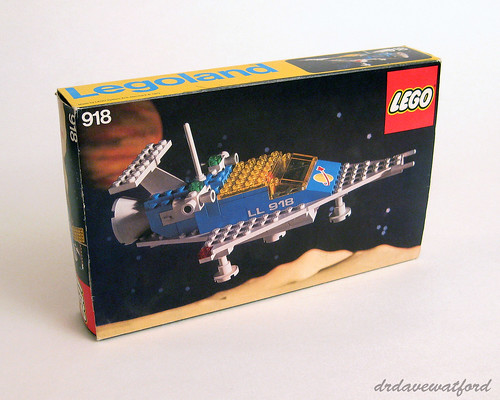
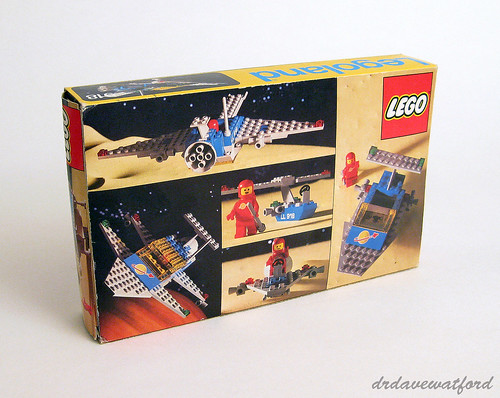
At just 23 cm wide by 14 cm tall by 4 cm deep the box is ultra slim and extremely compact. I assume that when new the set was shrink-wrapped in cellophane; alas my copy of the set was pre-owned when I bought it so I can't say for sure. The outer box is actually a slipcase, the front of which you can see above; this slides off to reveal an inner box which holds the pieces. The front of the slipcase carries a less than pin-sharp image of the set contents superimposed on a blurry starfield with a nearby planet top left and a barren lunar-like surface below. In addition to that we get the LEGO logo, the set number, and that's it; the 6+ age recommendation is relegated to one of the sides of the box and the set name is nowhere to be found. The rear of the slipcase (below) features photographs of a bunch of alternate builds which can be assembled using elements contained within the set. As stated in previous reviews I wish LEGO would provide such inspiration to today's builders, but the current fashion is to highlight play-features of the modern day sets on the back of the box instead.
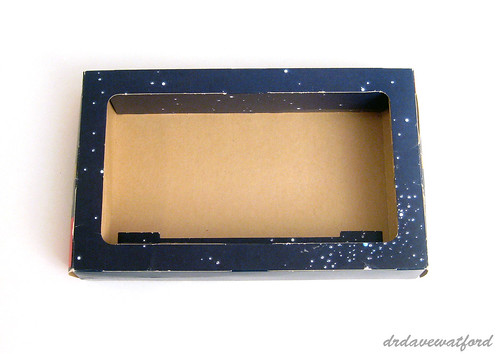
Removal of the slipcase reveals the appropriately decorated inner box (below) which features double-walled sides and is adorned with a star-field pattern reminiscent of the front of the slipcase. Unfortunately the double walls reduce the space available for the pieces, so that when they're bagged up it's hard to slide the slipcase over them.
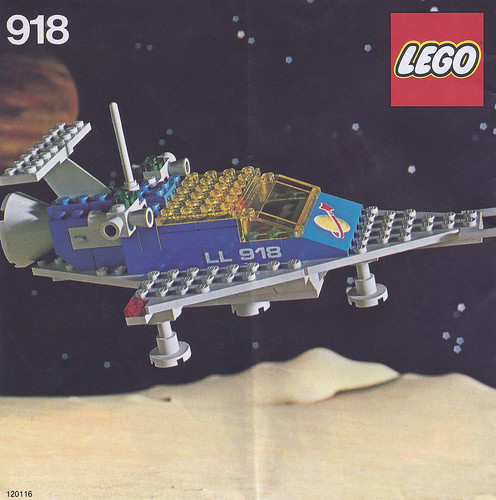
The cover of the instruction booklet, which looks pretty much the same as the front of the slipcase, can be seen below; I say 'booklet' but it's actually a single sheet measuring around 27 cm x 54 cm which is folded up into an approx. 13.5 cm x 13.5 cm square for storage. Unfolding the sheet reveals the clear and easy-to-follow building instructions which break the build into just 12 steps.
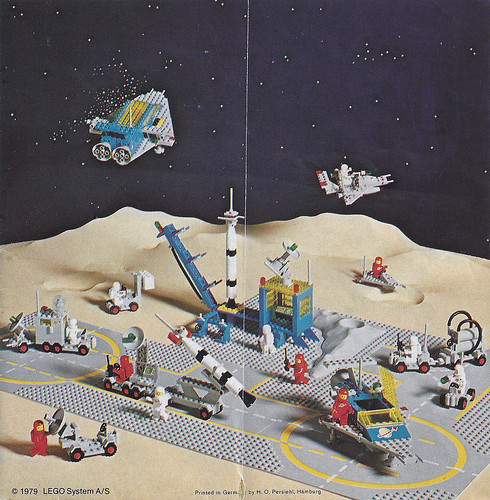
The building instructions take up almost all of the available space, with the two remaining panels being taken up by the cover art (above) and a diorama (below - click to enlarge) featuring a clutch of Classic Space sets. The same diorama picture also appears in the instruction leaflet for Set 894 Mobile Ground Tracking Station.
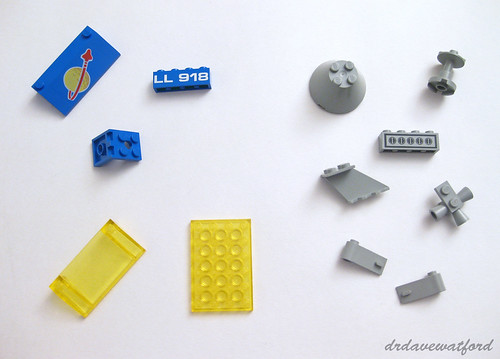
You can see selection of rare and/or interesting elements which can be found in the set in the picture below (click to enlarge). The blue 1 x 4 brick with the printed LL918 pattern is unique to this set, as is the light grey 1 x 4 brick with printed Homemaker stove switch pattern. The trans yellow 4 x 6 plate only appears in this and one other set, while the blue 33 degree 3 x 6 slope printed with the Classic Space logo and the light grey left and right 1 x 3 x 1 doors appear in a total of 5 sets. The trans yellow 33 degree 3 x 6 slope is a Classic Space staple and appears in a total of 9 sets. The other elements in the picture - the light grey stand, tail and 1 x 1 modified brick with positioning rockets, and the blue 2 x 2 - 2 x 2 bracket - are more commonly available, having initially appeared in the Classic Space sets and then subsequently been used in other themes.
Classic Space never went away for some of us, then, but for many it's taken the events of this year to remind them of its delights, or indeed to introduce it for the first time. In honour of this I thought I'd take a walk along memory lane and review another of the old Classic Space, um, classics - Set 918 One Man Space Ship, referred to by some sources as Set 918 Space Transport.
At just 23 cm wide by 14 cm tall by 4 cm deep the box is ultra slim and extremely compact. I assume that when new the set was shrink-wrapped in cellophane; alas my copy of the set was pre-owned when I bought it so I can't say for sure. The outer box is actually a slipcase, the front of which you can see above; this slides off to reveal an inner box which holds the pieces. The front of the slipcase carries a less than pin-sharp image of the set contents superimposed on a blurry starfield with a nearby planet top left and a barren lunar-like surface below. In addition to that we get the LEGO logo, the set number, and that's it; the 6+ age recommendation is relegated to one of the sides of the box and the set name is nowhere to be found. The rear of the slipcase (below) features photographs of a bunch of alternate builds which can be assembled using elements contained within the set. As stated in previous reviews I wish LEGO would provide such inspiration to today's builders, but the current fashion is to highlight play-features of the modern day sets on the back of the box instead.
Removal of the slipcase reveals the appropriately decorated inner box (below) which features double-walled sides and is adorned with a star-field pattern reminiscent of the front of the slipcase. Unfortunately the double walls reduce the space available for the pieces, so that when they're bagged up it's hard to slide the slipcase over them.
The cover of the instruction booklet, which looks pretty much the same as the front of the slipcase, can be seen below; I say 'booklet' but it's actually a single sheet measuring around 27 cm x 54 cm which is folded up into an approx. 13.5 cm x 13.5 cm square for storage. Unfolding the sheet reveals the clear and easy-to-follow building instructions which break the build into just 12 steps.
The building instructions take up almost all of the available space, with the two remaining panels being taken up by the cover art (above) and a diorama (below - click to enlarge) featuring a clutch of Classic Space sets. The same diorama picture also appears in the instruction leaflet for Set 894 Mobile Ground Tracking Station.
You can see selection of rare and/or interesting elements which can be found in the set in the picture below (click to enlarge). The blue 1 x 4 brick with the printed LL918 pattern is unique to this set, as is the light grey 1 x 4 brick with printed Homemaker stove switch pattern. The trans yellow 4 x 6 plate only appears in this and one other set, while the blue 33 degree 3 x 6 slope printed with the Classic Space logo and the light grey left and right 1 x 3 x 1 doors appear in a total of 5 sets. The trans yellow 33 degree 3 x 6 slope is a Classic Space staple and appears in a total of 9 sets. The other elements in the picture - the light grey stand, tail and 1 x 1 modified brick with positioning rockets, and the blue 2 x 2 - 2 x 2 bracket - are more commonly available, having initially appeared in the Classic Space sets and then subsequently been used in other themes.
It's hard to convey the excitement that I and other young LEGO fans felt back in the day when we were confronted with the Classic Space part and colour palette, some of which you can see above. To put things into context, up until the appearance of the Classic Space sets, the LEGO building experience had largely consisted of the use of basic elements in red, yellow, blue, white and black plus a smattering of trans clear elements, some light grey and green baseplates, and a few green trees. Then I opened my first Classic Space set and my senses were assaulted by trans yellow bricks, plates and slopes, small trans green and trans red plates and round bricks, light grey wedge plates, cones, positioning rockets, aircraft tails, stands and other exotica, and minifigures wearing space suits and carrying air tanks and radios. OK, so maybe if you weren't there you'll be scratching your head right now wondering what all the fuss was about, but trust me - at the time it felt like my LEGO world had been turned upside down, and for the better.
The set contains just one minifigure, but what a minifigure ! This red incarnation of probably LEGO's best-loved minifigure design of all time might look simple by today's standards but he's no less beautiful for that. Mine has managed to avoid one of the common Classic Space minifigure pitfalls, that of the cracked helmet strap lovingly parodied by Benny in the LEGO Movie, but as you can see in the picture above he's unfortunately fallen victim to the other - fading of his torso print; you can see what his torso print would have originally looked like here. His head has the standard grin pattern and isn't backprinted. You can get a good look at his airtanks in the picture below; this part first appeared as part of the Classic Space sets, and the same design is still in use to this day. This red version of the Classic Spaceman appeared in a total of almost 50 sets all told between 1978 and 1986.
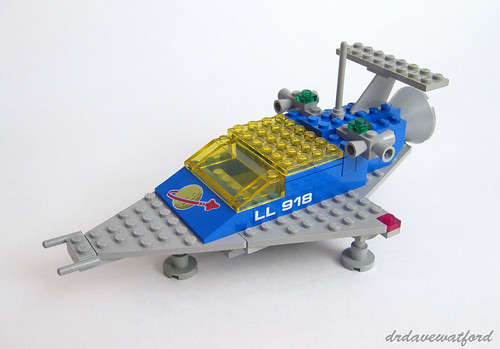
The build is predictably simple - literally a matter of just a few minutes - and you can see the finished model below (click to enlarge). It seems incredible that a set as small and quickly-assembled as this could be considered so ground-breaking, but you need to remember that pre-1978, LEGO models utilised basic bricks, slopes and plates; the appearance in 1978 of wedge plates and other more specialised elements, plus the expanded colour palette, revolutionised design possibilities and gave us LEGO spaceships which at the time seemed impossibly sleek and desirable. Many of the new elements are immediately evident - the blue 33 3 x 6 slope with the iconic Classic Space logo, the trans yellow windscreen and 4 x 6 plate which forms the cockpit roof, and the light grey wedge plates, positioning rockets and tail to name just a few.
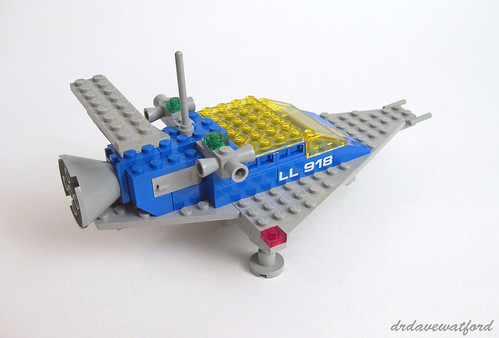
From behind you can see the large light grey cone, another of the new elements ushered in by the Classic Space revolution, and it's attached to the rear of the ship by the blue 2 x 2 - 2 x 2 bracket. The rear of the ship tapers neatly thanks to the use of more wedge plates.
As you can see from the picture below, there's more than enough space inside the cockpit for our Classic Spaceman; he sits behind a steering wheel and the light grey 1 x 4 brick with printed Homemaker stove pattern mentioned earlier which is used a a control panel. The trans yellow cockpit roof is attached via a pair of hinges on the right of the cockpit and it opens to provide cockpit access. The only other moving parts are the pair of light grey 1 x 3 x 1 doors on either side towards the rear of the craft.
In summary, Set 918 One Man Space Ship was released in 1979 and contains 81 parts; it appears to have only been released in Europe, Australia and Canada. It was one of a small, select group of much-loved and groundbreaking sets which were literally the start of an era, and whose appeal has IMHO deservedly endured to the present day. Old it may be, but I think this set has retained its charm in spades - great to look at, and also eminently swooshable. The enduring popularity of Classic Space sets in general is reflected in the aftermarket prices. At time of writing there are only 10 examples of this set listed for sale on Bricklink of which only 2 are boxed; the only used boxed example will set you back over £100 plus shipping, and if you want a mint, sealed copy then prepare to shell out almost £1,000 / US$1,500 for the privilege.... The set does periodically come up on eBay - that's where I got my copy a few years back - so keep your eyes peeled and you may get lucky.
The set contains just one minifigure, but what a minifigure ! This red incarnation of probably LEGO's best-loved minifigure design of all time might look simple by today's standards but he's no less beautiful for that. Mine has managed to avoid one of the common Classic Space minifigure pitfalls, that of the cracked helmet strap lovingly parodied by Benny in the LEGO Movie, but as you can see in the picture above he's unfortunately fallen victim to the other - fading of his torso print; you can see what his torso print would have originally looked like here. His head has the standard grin pattern and isn't backprinted. You can get a good look at his airtanks in the picture below; this part first appeared as part of the Classic Space sets, and the same design is still in use to this day. This red version of the Classic Spaceman appeared in a total of almost 50 sets all told between 1978 and 1986.
The build is predictably simple - literally a matter of just a few minutes - and you can see the finished model below (click to enlarge). It seems incredible that a set as small and quickly-assembled as this could be considered so ground-breaking, but you need to remember that pre-1978, LEGO models utilised basic bricks, slopes and plates; the appearance in 1978 of wedge plates and other more specialised elements, plus the expanded colour palette, revolutionised design possibilities and gave us LEGO spaceships which at the time seemed impossibly sleek and desirable. Many of the new elements are immediately evident - the blue 33 3 x 6 slope with the iconic Classic Space logo, the trans yellow windscreen and 4 x 6 plate which forms the cockpit roof, and the light grey wedge plates, positioning rockets and tail to name just a few.
From behind you can see the large light grey cone, another of the new elements ushered in by the Classic Space revolution, and it's attached to the rear of the ship by the blue 2 x 2 - 2 x 2 bracket. The rear of the ship tapers neatly thanks to the use of more wedge plates.
As you can see from the picture below, there's more than enough space inside the cockpit for our Classic Spaceman; he sits behind a steering wheel and the light grey 1 x 4 brick with printed Homemaker stove pattern mentioned earlier which is used a a control panel. The trans yellow cockpit roof is attached via a pair of hinges on the right of the cockpit and it opens to provide cockpit access. The only other moving parts are the pair of light grey 1 x 3 x 1 doors on either side towards the rear of the craft.
In summary, Set 918 One Man Space Ship was released in 1979 and contains 81 parts; it appears to have only been released in Europe, Australia and Canada. It was one of a small, select group of much-loved and groundbreaking sets which were literally the start of an era, and whose appeal has IMHO deservedly endured to the present day. Old it may be, but I think this set has retained its charm in spades - great to look at, and also eminently swooshable. The enduring popularity of Classic Space sets in general is reflected in the aftermarket prices. At time of writing there are only 10 examples of this set listed for sale on Bricklink of which only 2 are boxed; the only used boxed example will set you back over £100 plus shipping, and if you want a mint, sealed copy then prepare to shell out almost £1,000 / US$1,500 for the privilege.... The set does periodically come up on eBay - that's where I got my copy a few years back - so keep your eyes peeled and you may get lucky.
For more Classic Space goodness you might want to check out my review of Set 894 Mobile Ground Tracking Station or read some of my related ramblings here and here. Further Classic Space reviews to come in due course - it's always a pleasure to look back at these sets !
Labels:
918,
Classic Space,
lego,
one man space ship
Thursday, 7 February 2013
The Real Classic Space ?
As regular readers of this blog will know, I'm a massive fan of LEGO's so-called Classic Space sets. For the uninitiated, 'Classic Space' isn't an official LEGO title or theme, but the name given to a group of space-related sets produced by LEGO during the late 1970's and early to mid-1980's.
It's pretty easy to pinpoint the start of the Classic Space era, which was kick-started in 1978 by the North American release of four sets which were to become truly iconic and highly prized. I'm no LEGO historian, but I've always considered these sets, and those which followed close behind, to be truly ground-breaking on a number of levels. While their superb forward-thinking designs and wonderfully evocative branding and packaging weren't necessarily without precedent, there was also clear design DNA running through the sets as evidenced by the consistent colour schemes and parts they utilised. I can remember being wowed at the time by the first appearance of transparent parts in various colours, particularly yellow, green and red, not to mention a host of exotic new parts, both printed and unprinted. The early Classic Space sets were also the first LEGO space sets to feature the iconic LEGO minifigure. Like I said - groundbreaking on many levels. The end of the Classic Space era is perhaps a little tricker to pinpoint, simply because there was no break in the production of space sets, but most including the likes of Wikipedia cite 1987 as the cut-off. It was at this point that 'generic' LEGO space started to morph into sub-themes such as Futuron and Blacktron, with a shift away from the Classic Space design DNA as a consequence.
With all the hoo-ha about Classic Space, however, it's easy to forget that LEGO had already made their first forays into space many years earlier. As far back as 1964 LEGO released a 112-piece space set, imaginatively titled Space Rocket, and then in 1973 we were treated to Set 358 Rocket Base, which remains one of my favourite sets to this day and was the first LEGO space set that I ever owned. Two years later in 1975, Set 367 Space Module with Astronauts appeared, known in North America as Set 565 Moon Landing. That one unfortunately passed me by at the time, however, and it would be a few more years before I received my next taste of LEGO space in the form of the absolutely wonderful Set 928 Space Cruiser with Moon Base. As living proof of the old adage that "Good things come to those that wait", however, I recently managed to get hold of a boxed example of Set 367 Space Module with Astronauts almost 40 years after its release, and I thought I'd share it with you here.
The packaging consists of an inner box which contains the parts and instructions, and a decorated outer sleeve which slides over it . My copy of the set is a little worse for wear, particularly at the ends, but it's still largely intact. You can see the front of the outer sleeve below (click to enlarge) - wonderfully atmospheric and minimalist in contrast to the heavily branded and sometimes rather fussy box art we tend to get these days. That having been said, it's hard to shake the suspicion that the sun is in fact just an out of focus table lamp pointing at the camera through a sheet or similar....
The rear of the outer sleeve gives us something sadly long gone from most current LEGO sets - pictures of alternate builds. I can't speak for the rest of the oldies out there, but when I was a kid these alternate build ideas were a great source of inspiration for my own creations, and I miss them. A couple of the suggestions - the helicopter and the TV camera - are rather good.

Finally it's on to the lunar module itself. The upper section (below), known as the ascent stage, was an at times tricky build as you're required to place pieces on the rear aspect which can't actually be seen on the instructions; in the absence of part call outs this requires some educated guesswork.... The light grey engine pieces first appeared in a couple of sets released in 1974, one of which (Set 657 Executive Jet) I've reviewed previously. The iffy technique of vertically wedging a 1 x 2 plate between two studs crops up again in this part of the build, on this occasion providing support for the yellow radar 'dishes'
You can see all the various components of the set laid out below (click to enlarge). As well as the lunar module, moon buggy and 3 astronauts you're also provided with some additional equipment. The flag is stickered on both sides with the Stars and Stripes and sits on a 2 x 2 plate, and you also get a white radar 'dish' and some sort of rotating, floor-mounted device - bonus points for anyone who has a clue what that's supposed to be.... Mystery devices notwithstanding, it's a nice set with lots of play possibilities, and I would have been literally over the moon to get this when I was a youngster.
Set 367 Space Module with Astronauts was released in 1975. It contains 364 pieces, and according to Brickset it cost £3.95 back in the day. Having decided that I wanted the set, tracking down a boxed example on eBay predictably turned out to be a challenge due to the set's age and rarity, although they are occasionally listed there. I didn't initially check Bricklink as I assumed that the price of a boxed example on there would be more than I'd be willing to pay, but when I eventually got round to looking there I found exactly what I was looking for, located in the UK, and at a price which was below what I would have had to pay for any of the eBay auctions I'd been following. One of the reasons that Bricklink prices can be higher is that in marked contrast to eBay, sellers on Bricklink tend to be genuine LEGO enthusiasts who know how to clean, check and securely package their LEGO, and in general spend the necessary time and effort doing so; it was therefore no surprise that the set turned up well packaged, complete and clean. At the time of writing there are only eight copies of the set on Bricklink, plus a further four copies of sister set 565 Moon Landing; unboxed they're priced between £25 and £77 depending on location and condition, while a boxed example will set you back £86 and up.
There's no doubt that this set has charm, and as a child I would have absolutely loved it. Even so, it's easy to see why the appearance of LEGO's next generation of space sets just 3 years later - the start of the Classic Space era - caused such a stir. When you compare the images of Set 367 above with, for example, Set 928 Space Cruiser and Moon Base (below - click to enlarge) from 1979, the progression in terms of parts, colours and sophistication is just massive - truly a giant leap for mankind....
With all the hoo-ha about Classic Space, however, it's easy to forget that LEGO had already made their first forays into space many years earlier. As far back as 1964 LEGO released a 112-piece space set, imaginatively titled Space Rocket, and then in 1973 we were treated to Set 358 Rocket Base, which remains one of my favourite sets to this day and was the first LEGO space set that I ever owned. Two years later in 1975, Set 367 Space Module with Astronauts appeared, known in North America as Set 565 Moon Landing. That one unfortunately passed me by at the time, however, and it would be a few more years before I received my next taste of LEGO space in the form of the absolutely wonderful Set 928 Space Cruiser with Moon Base. As living proof of the old adage that "Good things come to those that wait", however, I recently managed to get hold of a boxed example of Set 367 Space Module with Astronauts almost 40 years after its release, and I thought I'd share it with you here.
The packaging consists of an inner box which contains the parts and instructions, and a decorated outer sleeve which slides over it . My copy of the set is a little worse for wear, particularly at the ends, but it's still largely intact. You can see the front of the outer sleeve below (click to enlarge) - wonderfully atmospheric and minimalist in contrast to the heavily branded and sometimes rather fussy box art we tend to get these days. That having been said, it's hard to shake the suspicion that the sun is in fact just an out of focus table lamp pointing at the camera through a sheet or similar....
The rear of the outer sleeve gives us something sadly long gone from most current LEGO sets - pictures of alternate builds. I can't speak for the rest of the oldies out there, but when I was a kid these alternate build ideas were a great source of inspiration for my own creations, and I miss them. A couple of the suggestions - the helicopter and the TV camera - are rather good.
Sliding off the outer sleeve reveals the parts and instructions sitting in a plain cardboard tray; when the set was new you'd also have found a sticker sheet in there, but those stickers that remain in my used copy of the set have already been applied. The instructions are in the form of a double-sided sheet akin to a poster rather than a booklet; folded up they occupy a modest area (front cover below) but fully unfurled they're huge !
The building instructions themselves occupy a little over three quarters of the available space. There are no part call-outs, and some of the building steps are quite hard to follow, although an attempt is made to try and help the builder by printing a thick magenta line around the newly-added parts in some of the building steps. The instructions culminate in the image below which shows the completed build.

Some of the pictures of alternate models featured on the outer sleeve are repeated on the instruction sheet (below) although you don't get building instructions for these, so if you want to reproduce them then you're on your own.
Buying a set this old is often something of a lottery - even if you've seen photographs of the packaging before you buy you're never quite sure what horrors will await you inside the box.... I was lucky, though - all parts were present and correct, and they furthermore lacked the dust and grime that's often an unexpected 'bonus' when you buy a used set.
The set contains 3 maxifigures; if anyone is unfamiliar with these precursors to the modern minifigure and wants to know more about them, I've previously posted here on the subject so you can get up to speed. Unusually, but appropriately given the subject matter, the set calls for brick-built helmets rather than the typical maxifigure heads. You can see one of the maxifigure astronauts below. It's pretty impressive that after 40 years the sticker is still attached; OK, so it could have been applied a bit more neatly, but after all this time I'm just grateful that any of the stickers have survived at all....
While helmets as above are obviously the order of the day given the lunar setting, the set also includes three maxifigure heads and hairpieces so that the astronauts can let their hair down at the end of a hard day's space walking; it's a nice touch which enhances the play possibilities of the set.
Having completed the figures, it was on to the moon buggy next, and you can see the finished article below (click to enlarge). The building instructions zoom through this in just 8 steps; it'd probably be more like 80 steps today ! Interesting parts include the fully intact milky white antenna which is typically found with less than its full complement of 8 spokes, the multiple white 1 x 1 round bricks with a solid stud on top, and the front engine grille which is etched into the side of a blue 1 x 6 brick as opposed to just being printed on the surface. The 'control stick', which is made up of two red 1 x 2 plates, is wedged vertically between two studs on the floor of the moon buggy; this would be considered an "illegal" building technique by LEGO nowadays and thus wouldn't make it into an official set.
Finally it's on to the lunar module itself. The upper section (below), known as the ascent stage, was an at times tricky build as you're required to place pieces on the rear aspect which can't actually be seen on the instructions; in the absence of part call outs this requires some educated guesswork.... The light grey engine pieces first appeared in a couple of sets released in 1974, one of which (Set 657 Executive Jet) I've reviewed previously. The iffy technique of vertically wedging a 1 x 2 plate between two studs crops up again in this part of the build, on this occasion providing support for the yellow radar 'dishes'
The lower section of the lunar module (below), known as the descent stage, consists of four identical legs attached to a boxy central section. It was very quick and easy to assemble. The non-retractable ladder, which attaches to the central section via a vintage 2 x 5 hinge plate, doesn't reach the ground which does beg the question of how our intrepid astronauts are supposed to get back on board. Oh well - in low G they can just jump, I guess....
The ascent stage fits snugly into a 2 x 5 stud-sized slot at the top of the descent stage and the lunar module is complete (below). The ascent stage is held in place by a couple of studs on either side. All that's missing is the sticker of the Stars and Stripes which is supposed to adorn the side of the lunar module but which sadly didn't survive the ravages of time. Given that the sticker would have covered multiple bricks, it's absence is unsurprising; if I'd owned the set as a kid I would have wanted to reuse the bricks so the sticker wouldn't have lasted 5 minutes....
You can see all the various components of the set laid out below (click to enlarge). As well as the lunar module, moon buggy and 3 astronauts you're also provided with some additional equipment. The flag is stickered on both sides with the Stars and Stripes and sits on a 2 x 2 plate, and you also get a white radar 'dish' and some sort of rotating, floor-mounted device - bonus points for anyone who has a clue what that's supposed to be.... Mystery devices notwithstanding, it's a nice set with lots of play possibilities, and I would have been literally over the moon to get this when I was a youngster.
Set 367 Space Module with Astronauts was released in 1975. It contains 364 pieces, and according to Brickset it cost £3.95 back in the day. Having decided that I wanted the set, tracking down a boxed example on eBay predictably turned out to be a challenge due to the set's age and rarity, although they are occasionally listed there. I didn't initially check Bricklink as I assumed that the price of a boxed example on there would be more than I'd be willing to pay, but when I eventually got round to looking there I found exactly what I was looking for, located in the UK, and at a price which was below what I would have had to pay for any of the eBay auctions I'd been following. One of the reasons that Bricklink prices can be higher is that in marked contrast to eBay, sellers on Bricklink tend to be genuine LEGO enthusiasts who know how to clean, check and securely package their LEGO, and in general spend the necessary time and effort doing so; it was therefore no surprise that the set turned up well packaged, complete and clean. At the time of writing there are only eight copies of the set on Bricklink, plus a further four copies of sister set 565 Moon Landing; unboxed they're priced between £25 and £77 depending on location and condition, while a boxed example will set you back £86 and up.
There's no doubt that this set has charm, and as a child I would have absolutely loved it. Even so, it's easy to see why the appearance of LEGO's next generation of space sets just 3 years later - the start of the Classic Space era - caused such a stir. When you compare the images of Set 367 above with, for example, Set 928 Space Cruiser and Moon Base (below - click to enlarge) from 1979, the progression in terms of parts, colours and sophistication is just massive - truly a giant leap for mankind....
Labels:
367,
565,
Classic Space,
Homemaker,
lego space,
Moon Landing,
Space Module with Astronauts
Subscribe to:
Posts (Atom)


.jpg)
.jpg)
.jpg)


.jpg)
.jpg)
.jpg)
.jpg)
.jpg)
.jpg)