

About a year and a half ago I was idly eBrowsing and I stumbled across a used example of the set above, Set 355 Town Center Set with Roadways. It was being sold complete with box, instructions and even some left-over stickers, and I was very tempted. Fully expecting the item to sell for more than I was willing to pay I nevertheless placed a speculative bid, more in hope than expectation, and against the odds I won the auction. A few days later the set arrived.

The box, as you can see above (click picture to enlarge), is far from perfect but it's still very much intact. The front of the lift-up cover shows the contents of the set against a neutral background, and that's pretty much it, apart from the classic "Legoland" branding and the LEGO Logo of the time in the bottom right-hand corner. The back of the box (below) features a number of panels which highlight a few aspects of the set, as well as showing a couple of rather serious-looking kids building and playing with the models; the right side shows a portion of the cardboard base, which we'll get on to shortly.

Lifting the lid is a joy; within the box is a polystyrene/styrofoam inner tray which snugly houses three smaller removable cardboard boxes. The largest of these boxes contains the parts for the garage, the medium sized box contains the parts for the crane, chalet, flatbed truck and white sports car, and the smallest contains the parts for the digger and tipper truck. The two largest boxes have a plastic-lined window in the front so you can see the parts within. You can see the arrangement of boxes in the picture below; by this point I had removed the parts from each of the boxes in preparation for building.

All the models are designed to be accommodated on a cardboard baseplate around 50 cm square which you can see in the picture below. The base folds in half and slides inside the lid of the set box for storage - if you look closely you can see it peeking through the cut-away on the inside of the box lid on either side of the little boy's face in the picture above. Overall it's a beautifully packaged set, and I was delighted to find the inner packaging in such great shape.

The set is supplied with just one instruction booklet, and at just 16 pages long and less than 14 cm square the booklet offers a masterclass in brevity and efficiency; the largest model in the set, the garage, is disposed of in just 9 building steps split over 4 pages. At first glance the cover of the booklet looks a bit of a mess; it's only when you fully open out the booklet and view the front and back covers together (picture below) that you get the full picture.

You can see a sample page of the instruction booklet below showing all of the completed models in situ on the cardboard baseplate; obsessives may have spotted that some of the vehicles and road signs are in different positions in the picture below compared with their positions in the image on the front of the box. Life's probably too short to worry about such things, however, so you're probably better off not having noticed it....

The set comes supplied with two sticker sheets, and incredibly they were both present and almost mint in the copy of the set that I purchased. LEGO generously supplied stickers representing eleven different nations to stick on the flag pole, and if none of those was suitable then you had a more generic LEGO flag that you could use. Evidently the person that originally owned my copy of the set was a Brit and thus used the Union Jack stickers, but all the other stickers were left alone, and more than 40 years later they still look pristine and ready to use.


I would have built this set shortly after receiving it were it not for the fact that when I checked the contents against the online inventory at Bricklink I discovered that almost 30 out of the set's intended 332 parts were missing. Many of the missing parts were older variants of common parts, e.g. 2 x 4 bricks without cross-supports, 1 x 1 round bricks with solid studs (as opposed to hollow studs) and 2 x 2 tiles without grooves at the base. While these older variants are in many cases not functionally different to their modern counterparts, having chanced upon an antique set which was in many respects in decent condition, I figured that I should try and do it justice by sourcing the correct older variants of the missing parts rather than substituting them with modern equivalents. Interestingly, the older variants can often be sourced fairly easily via Bricklink, and they don't always command higher prices than their modern counterparts; I gradually sourced them over time, finally completing the job of replacing all the missing parts fairly recently.

Those elements that weren't missing were, I must say, in absolutely magnificent condition for their age - the trans clear parts weren't discoloured, printed parts weren't faded, and everything looked nearly new which is pretty astonishing after more than 40 years. You can see a photograph of some of the more interesting elements above. While not all of them are rare, many of them are long-retired and should trigger a pleasing trip down memory lane for some older readers ! The set contains two of the black 1 x 4 bricks with white Legoland logo pattern; these appeared in only 5 sets in total, the most recent of which was released in 1973. The set also contains red and yellow versions of the Legoland brick. The old-style 4 x 4 turntables (black variant shown above) were phased out in 1976, while the red 1 x 2 brick with SHELL logo only ever appeared in 4 sets, between 1966 and 1972. Trans clear 2 x 4 bricks haven't been available for years; the one in the picture above is an old-style 2 x 4 brick without cross supports, which was pretty common in the 70's. I had (and still have) quite a few of them, although they've all become discoloured to a lesser or greater extent over the years, unlike the example in the picture which is in really good condition. The antennae were notorious for losing their side spokes, so it's nice to see an intact example. The set also contains white, blue and red 1 x 4 bricks with a car grille pattern. The pattern is actually embossed rather than printed, and is embossed in silver on the blue and red bricks and in black on the white brick. This version of the white 1 x 8 brick with 'GARAGE' printed on it only ever appeared in 3 sets, while the yellow 2 x 2 brick printed with the old-style LEGO logo appeared in 4 sets. My one minor disappointment is that this set originally included either a large pine tree or a more interesting (and much rarer) granulated bush with 3 trunks, and my example unfortunately contains the large pine. Finally, you can see the 'missing' Union Jack flag from the sticker sheet neatly applied to the flag pole


A couple of the baseplates (pictures above) included in the set are also worth a mention. The larger of the two, which measures 24 x 32 studs, is predictably unique to the set. It features rounded corners and three studless, textured driveways each of which covers an area of 4 x 20 studs. Some of the studs have white printing on top to help the builder quickly identify where to place the first layer of elements. Given the general lack of hand-holding inherent in older sets compared with more modern builds, it seems strange that LEGO used to print baseplates in this way. The smaller baseplate shown above, which measures 14 x 20 studs, also features stud printing and is once again unique to this set. It lacks the exaggerated rounded corners shown in the instruction booklet and the images on the box, and according to Bricklink it's a known variant in this set.
The build itself was fairly straightforward, with the garage first up for construction. One thing I immediately noticed when I started to build was that the clutch on the bricks was significantly greater than I'm used to, making the elements harder to push together, and also harder to take apart; I'm pretty sure that this is just down to the age of the bricks. The red 1 x 2 bricks with SHELL logo mentioned earlier are utilised in the construction of a couple of petrol pumps, and you can see the large pine tree behind the petrol pumps looking ugly (did I mention that I would have preferred the granulated bush with 3 trunks instead....?!). The two blue doors at the front of the garage do open, but there's no interior detail within the building.


Next up is the crane, which utilises the black 1 x 4 Legoland-embossed bricks described earlier. This structure also incorporates the aforementioned 4 x 4 turntable plus an old-style winch with metal handle to provide some play features. The winch contains a reel, around which string is wound; a metal handle attached to the reel can be rotated to wind/unwind the string and thus lift/lower the load at the end of the string. This kind of winch arrangement was very common in the sets of my youth, and as a kid I spent countless hours trying to securely tie one end of the string to the reel while threading the other end (which was almost invariably frayed) through the tiny hole in the hook to attach it. Happy days....


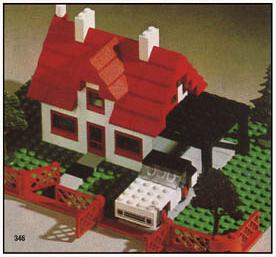
The final structure is the chalet. This incorporates a number of old-style windows and doors, as well as the previously highlighted antenna with spokes. The red windows with shutters at the front of the house are rarer than I thought, having only ever appeared in 5 sets according to Bricklink. I never owned any of those 5 sets as a child, but I nevertheless have a bunch of red windows with shutters in my childhood LEGO collection, so it's a genuine mystery where they came from. The 33 degree slope bricks used for the roof are commonplace now but their first ever appearance in sets was in 1971 so they must have seemed deliciously new and exotic back in 1972 when this set was released.


The set comes with four vehicles, all of them elegant in their simplicity IMHO and a reminder of how straightforward LEGO vehicles were in my youth. The tipper truck (below) was assembled first, with its immaculate silver embossed engine grille and Legoland branding on the working tipper bed. You can see the lack of a groove at the base of the black 2 x 2 tiles as mentioned previously; given the increased clutch I'm not looking forward to trying to remove those tiles at a later date without damaging them....

The digger (below) features a few of the retired elements that I touched on earlier, including the black 1 x 1 round brick with a solid stud (the studs are hollow these days) and the yellow 2 x 2 brick printed with an old-style LEGO logo. There are a few other vintage elements used here as well - the bucket and bucket arm, the wheels and the wheel holders are all long-since retired.

The sports car is pretty unremarkable, although it's nice to see the white embossed 1 x 4 brick with engine grille in such spritely condition, and the same goes for the windscreen which you'd normally expect to have discoloured to some extent after all these years.

Lastly, there's a flatbed truck (below). Although the design is pretty basic, it does feature a couple of blue 45 degree 2 x 2 double concave slopes at the front which are fairly uncommon, not to mention a(nother) immaculate 1 x 4 brick with embossed engine grille. The six black round 1 x 1 bricks with solid stud on the back act as a guide to hold the cargo in place once it's been dropped in place by the crane.

With all the buildings and vehicles assembled, all that was left for me to do was to drop the buildings into their allocated spaces on the cardboard baseplate, place the vehicles into suitable positions, add the selection of roadsigns provided with the set, and we're done. I don't know about the rest of you oldies out there, but even my picture below (click to enlarge) of the completed set with everything in place gives me a warm, nostalgic feeling inside, let alone the actual model itself which is currently occupying my dining room table and which I can't bear to move. I suppose that by today's standards it could reasonably be argued that all the models are simplistic and lacking in detail, but if I'd owned this set as a kid I would have been ecstatic, and even now I think that it all comes together beautifully.

To coin a well worn cliche, they don't make 'em like they used to.... We've had a bunch of "Town Plan"-type sets over the years, most recently 2013's Set 60026 Town Square, but it's been a while since the often-substantial collection of buildings, vehicles and (more recently) minifigures which make up these sets has been pulled together into a cohesive whole by the use of one or more large baseplates; honestly, I think there are a number of recent sets that would substantially benefit from this treatment.

Set 355 Town Center Set with Roadways was released in 1972 and contains either 332 or 336 parts depending on whether you're more inclined to trust Bricklink or Brickset. As stated previously, I found my copy of the set on eBay, although that was the only time I've ever seen the set for sale there and there don't currently appear to be any copies for sale on either ebay.co.uk or ebay.com. If you're looking to buy, Bricklink is probably your best bet; at the time of writing there are 16 copies of the set on sale there in various states of repair and completeness. A new, sealed copy will set you back almost £300 plus shipping, while a used, boxed and complete example will cost about half as much, and if you're not fussed about the box then you're looking at considerably less.


.jpg)
.jpg)
.jpg)
.jpg)
.jpg)
.jpg)
.jpg)
.jpg)
.jpg)
.jpg)
.jpg)